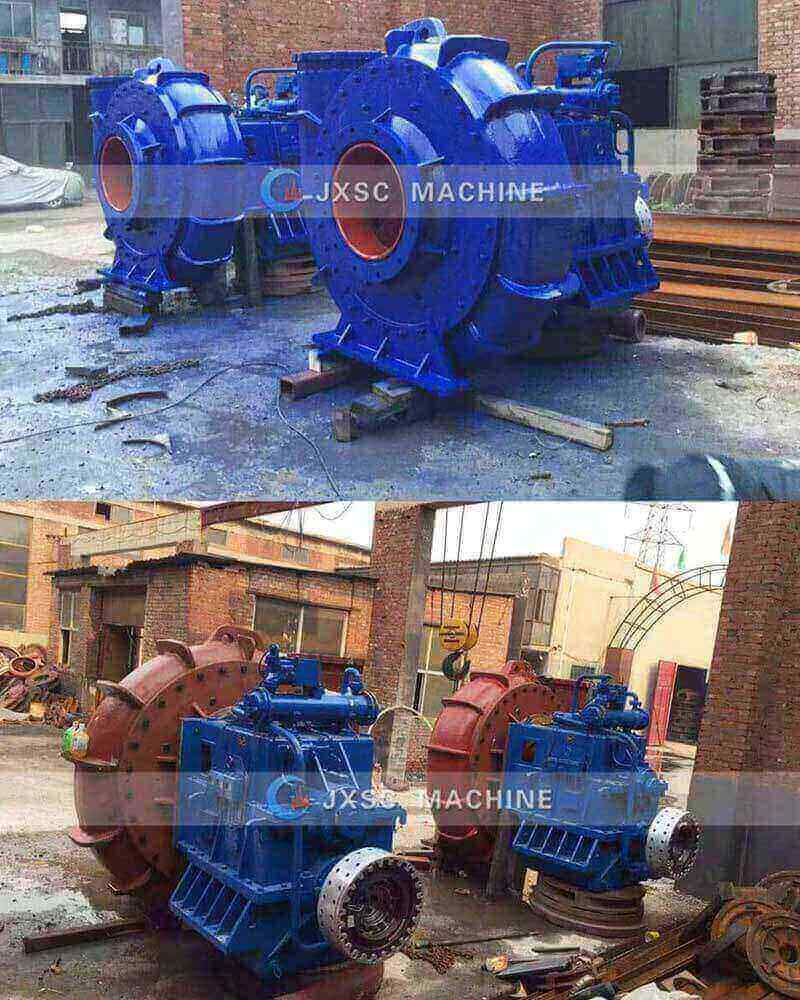
Application: Optimized dredge pump for mineral processing scenarios; these products are suitable for slurry transportation and tailings discharge. Their performance meets national industry standards, making them a core piece of conveying equipment in mining, dredging, and other fields.
A dredge pump, also known as a mud pump, is a specialized centrifugal pump designed to transport liquid-solid mixtures containing solid particles. Its core flow components are made of wear-resistant alloys, allowing for stable operation under high-wear conditions. Its core function is to efficiently transfer slurry containing mud, ore particles, or other solid impurities from one location to another using powerful centrifugal force or positive displacement.
Compared to ordinary water pumps, dredge pumps offer higher wear resistance, anti-clogging capabilities, and the ability to handle large particles. They typically utilize high-chromium alloys, rubber linings, or special coatings to extend their service life. In the mineral processing industry, dredg pumps are indispensable equipment in tailings treatment, slurry transportation, and mining operations, directly impacting production efficiency and operating costs. Their design must consider key parameters such as flow rate, head, and solid particle throughput to adapt to different operating conditions. In the mineral processing industry, it is an indispensable piece of conveying and auxiliary equipment for tailings treatment, slurry transportation, and mining operations.
Core Application Scenarios
Mining and Mineral Processing: Suitable for slurry transportation, tailings discharge, and slurry recycling in mineral processing for both metallic and non-metallic ores.
Water Conservancy and Dredging: Used for dredging rivers, lakes, and reservoirs, and for transporting mud and gravel in waterway dredging projects.
Port and Maritime: Supports underwater sand and gravel transportation in port construction, waterway widening, and land reclamation projects.
Environmental Protection and Energy: Can be used for sludge transportation, fly ash transportation, coal slime transportation, and other environmental and energy production scenarios.
features of dredge pump
WN-type sludge pumps have strong self-priming ability, strong suction height, few parts of the screw pump, compact structure, small volume and simple maintenance. It is a new type of pump made according to the principle of revolving meshing displacement.
The main working parts of the G-type sludge pump are the eccentric screw (rotor) and fixed bushing (stator). Use non-toxic and tasteless edible rubber; the working temperature can reach 120 degrees Celsius. You can contact us if you use a high temperature of 120 degrees Celsius-350 degrees Celsius.
Due to the special geometric openings of the two components, separate sealed chambers are formed. The medium promotes the flow evenly from the axial direction. The internal flow rate is low, the volume remains unchanged, and the pressure is stable, so there will be no product turbulence and agitation. The output pressure of each pump is 0.6MPa-1.2MPa, the head is 60m-120m (clean water), and the self-priming height is generally above 3m. It can be used as a self-priming sewage pump product.
Principle & Structure Of dredge pump
How It Work?
Dredge pumps transport slurry primarily through centrifugal force or reciprocating piston motion. Taking a common centrifugal mud pump as an example, the motor drives the impeller to rotate at high speed, creating a low-pressure zone within the pump chamber. The slurry is drawn into the inlet due to the pressure difference. The impeller blades transfer kinetic energy to the slurry, giving it the energy for high-speed flow. Subsequently, the kinetic energy is converted into pressure energy through the volute or guide vanes, and finally discharged from the outlet.
Pump Body Casing: Double-casing structure with inner and outer layers. The inner layer can be replaced separately after wear. A single-casing structure is more suitable for small to medium-sized applications.
Impeller: The core power component is made of wear-resistant alloy casting and optimized for fluid dynamics to achieve high head and high flow rate delivery.
Transmission System: Includes pump shaft, bearings, and coupling, equipped with a lubrication and cooling structure to ensure long-term stable operation.
Sealing Device: Composed of sealing rings and stuffing boxes to reduce slurry backflow and leakage, ensuring stable vacuum in the pump chamber.
Why Choose JXSC Dredge Pump
Advantages Of Dredge Pump
Wear-resistant and durable: Utilizing high-chromium alloys and ceramic linings, its lifespan is 3-5 times longer than ordinary pumps, reducing replacement costs.
High-efficiency conveying: Optimized hydraulic design ensures continuous and stable conveying of high-concentration slurries (solid content up to 60%-70%).
Large particle handling capacity: Wide flow channels and an anti-clogging structure can handle rocks or slag blocks with diameters exceeding 100mm.
Low maintenance requirements: Modular design allows for quick replacement of wear parts, reducing downtime.
Energy-saving and environmentally friendly: Equipped with variable frequency technology, power is adjusted according to operating conditions, reducing energy consumption by 15%-30% compared to traditional pumps.
Anti-clogging: The wide flow channel design allows solid particles up to 350mm to pass through, significantly reducing the probability of clogging.
Strong adaptability: Dual-purpose design for land and sea use, suitable for freshwater, seawater, or corrosive media environments.
Intelligent monitoring: IoT interface transmits pressure and temperature data in real time, preventing sudden failures.
Highly adaptable: Available in horizontal, vertical, and submersible installation options; custom-designed explosion-proof and corrosion-resistant configurations are also available.
Customized services: Flow rate, head, and other parameters can be customized according to customer needs.