Mineral Processing » Solutions » Tungsten Ore Processing
Tungsten Ore Processing
Tungsten ore is mainly divided into two categories: wolframite and scheelite. Wolframite is high-density and weakly magnetic, and can be efficiently enriched by gravity separation. Scheelite is often characterized by fine-grained disseminated particles and numerous associated impurities, and is typically recovered using a combined flotation process.
JXSC customizes exclusive beneficiation processes for tungsten ores with different endowments, covering a complete flow combination including washing, crushing, screening, grinding, gravity separation, flotation, and magnetic separation. It can stably achieve a recovery rate of 90%+ and a concentrate grade (WO₃) ≥65%. Our tungsten ore processing solutions can significantly reduce tailings losses, helping you achieve high returns and meet industrial application standards.
Tungsten Beneficiation process
1. Wolframite Beneficiation Solutions
About Wolframite Ore
Wolframite has the chemical composition (Fe, Mn)WO₄ and a density of 7.2-7.5 g/cm³, which is 2-3 times that of common gangue minerals. It is weakly magnetic, has a Mohs hardness of 5-5.5, and is brittle and easily over-crushed. Its embedded particle size is mostly coarse, with a significant density difference compared to gangue. It is easily separated by physical methods, but its floatability is poor. It often occurs in association with quartz, cassiterite, molybdenite, and sulfide minerals, with primary ore having a WO₃ grade mostly in the range of 0.1%-0.5%.
Wolframite beneficiation follows the principle of “early and rapid collection, grading, and separation,” with a combined process primarily based on gravity separation, yielding good results. Coarse particles can be quickly enriched using jigs or spiral sluices, while fine particles require shaking tables or flotation (using oleic acid collectors). Fine separation uses magnetic separation to separate weakly magnetic impurities (such as manganese minerals) and electrostatic separation to remove non-conductive minerals such as quartz.
2. Scheelite beneficiation solutions
About Scheelite Ore
Scheelite has the chemical composition CaWO₄, a density of 5.8-6.2 g/cm³, and a Mohs hardness of 4.5-5. It exhibits a pale blue fluorescence under ultraviolet light and has good natural floatability. Its intercalated grain size is generally fine, and it often occurs in association with calcareous gangues such as calcite and fluorite, as well as sulfide minerals. The flotation characteristics of calcareous gangues are similar to those of scheelite, making separation difficult.
Scheelite beneficiation mainly employs a process route that prioritizes flotation and supplements it with gravity separation. Grinding is first performed to a fineness of -200 mesh (70%-80%) to ensure liberation of individual minerals. For coarse-grained intercalated ores, pre-enrichment through gravity separation can reduce costs. Roughing is done using a lime method combined with fatty acid collectors to enrich scheelite, while cleaning uses heated flotation to suppress calcareous gangues. The final tungsten concentrate grade can consistently reach over 65%.
tungsten ore processing plant
1. Wolframite Magnetic Separation
10TPH Wolframite Crushing & Gravity-Magnetic Separation Plant
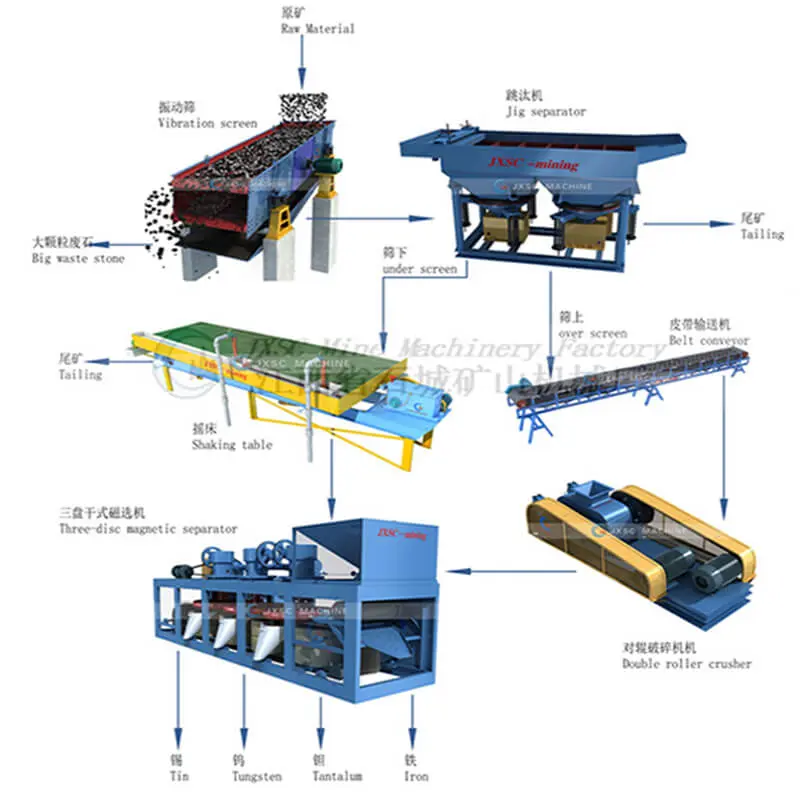
Multi-stage crushing (coarse jaw crusher, fine jaw crusher) –> screening —> jig separators (roughing separation) –> grinding and classification –> shaking table (fine separation) –> dry magnetic separation.
- The vibrating feeder evenly feeds large lumps of ore into the large jaw crusher.
- The large jaw crusher crushes large lumps of ore into smaller pieces. A chute feeder feeds the smaller lumps of ore into the coarse jaw crusher, which then feeds the fine jaw crusher and then the double-roll crusher to produce the final fine sand.
- The vibrating screen separates the final fine sand into 0-2 mm and 2-6 mm sizes, which are then fed into different jig concentrators.
- The jig concentrator concentrates the 0-2 mm and 2-6 mm tungsten concentrates.
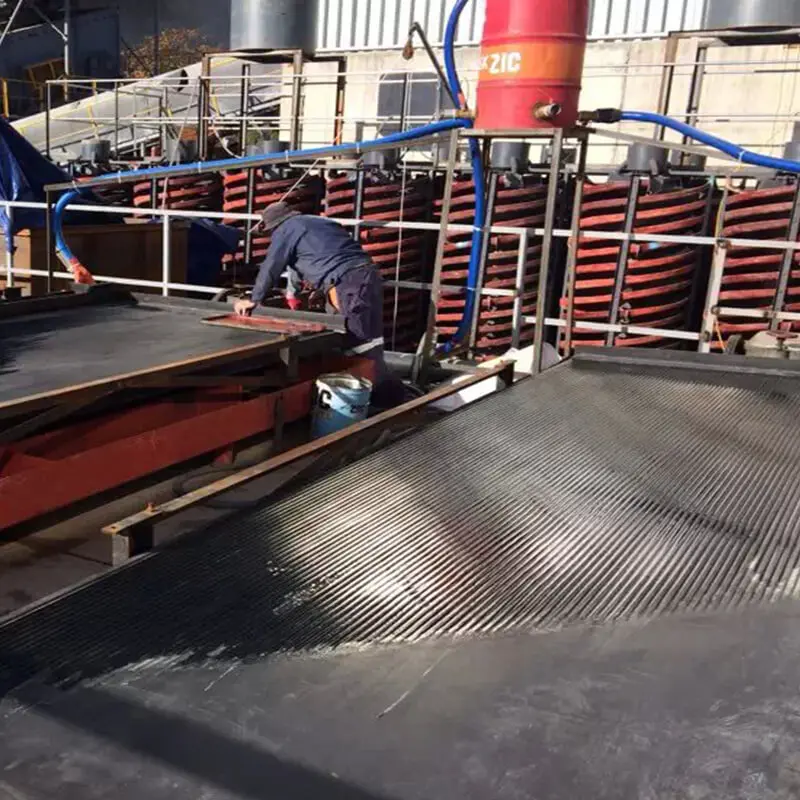
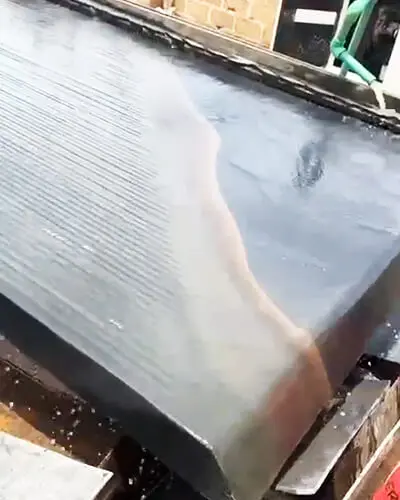
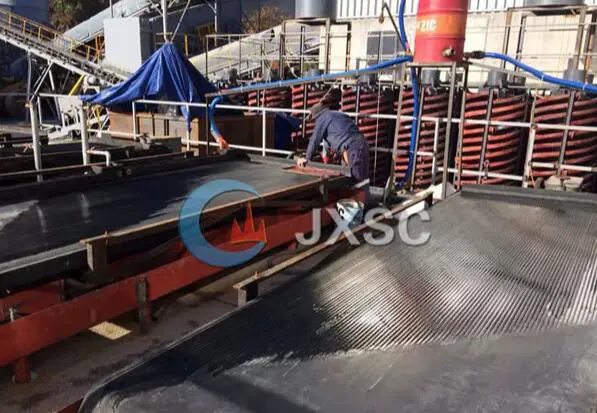
- The shaking table is used to recover tungsten from the 0-2 mm tailings from the jig concentrator.
- A spiral classifier and rod mill are used to grind the 0-6 mm tailings from the jig concentrator to a final particle size of 0-2 mm. The tailings are then fed to the jig concentrator for tungsten concentrate concentration. The jig concentrator tailings are then pumped to a vibrating screen.
- A small double-roll crusher is used to crush the 2-6 mm tungsten concentrate to a final particle size of 0-2 mm.
- A three-disc dry magnetic separator is used to re-separate the 0-2 mm tungsten concentrate from the jig concentrator and shaking table concentrators.
If the raw ore particle size is 150 mm and the grade is 2-5%, the ore grade can reach over 65% by using the tungsten ore processing equipment provided by JXSC Mining Machinery Factory.
2. Scheelite flotation process

Scheelite Flotation Flow
- Crushing & screening: Three-stage crushing is used here to crush ore, enter the vibrating screen for screening and the particle size reaches the following grinding condition.
- Grinding and grading: The crushed ore is further finely ground by grinding & classifying equipment (ball mill and spiral classifier) to improve mineral particles’ exposure and floatability to meet the flotation treatment’s particle size.
- Flotation: By adding reagents to the flotation machine, the ore particles absorb air bubbles and float up to realize the separation of tungsten. If needed, the impurities and mud in the ore are often separated from the concentrate by a cyclone.
- Concentration: Use thickeners to concentrate the deslimed flotation concentrate on reducing the impurity content and improving the grade of tungsten.
- Dewatering: The concentrated ore is dehydrated through a vacuum filter press to make it a relatively dry concentrate.
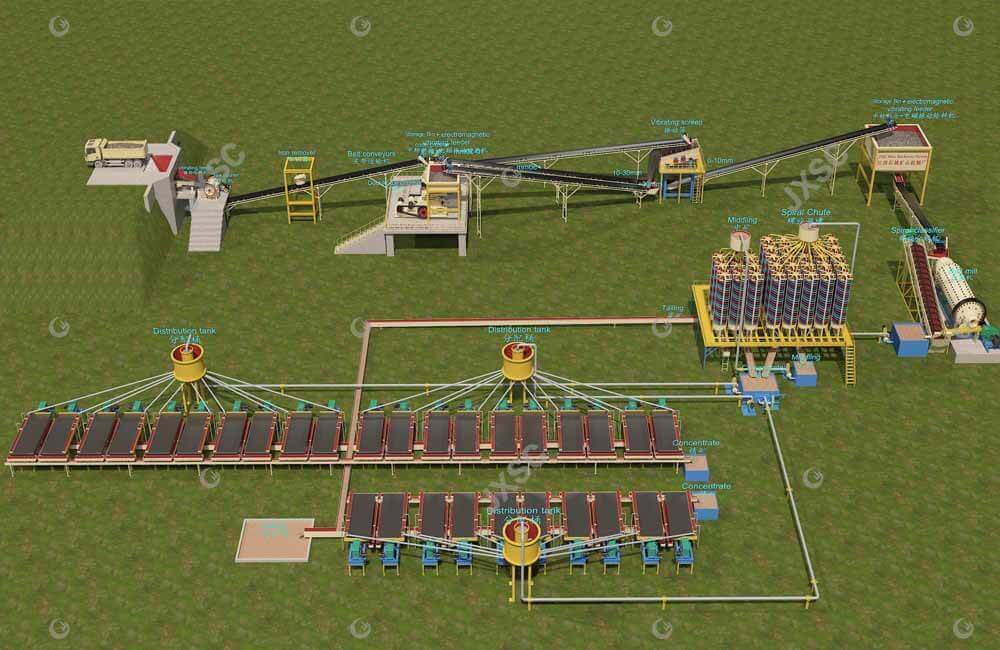
tungsten ore (with clay) processing solution
Tungsten Washing & Gravity Separation Flow
- Raw material will feed to the vibrating screen for sieving larger than 4mm waste sand and 0-4mm materials to the high-frequency vibrating screen.
- High frequency vibrating screen for sieving 0-40 mesh materials to the tailings blanket recycling machine, 40 mesh -4mm materials will go to the jig separator.
- Jig separator for recovering the tungsten concentrate roughly. The shaking table for refining the concentrate from the jig separator, and the mid concentrate from the 1st stage shaking table will go to the 2nd stage shaking table for recovering again.
- Tailings blanket recycling machine for recovering the tungsten from the 0-40 mesh materials. The spiral chute is for refining the concentrate from the tailings blanket recycling machine.
- The shaking table for refining the concentrate from the spiral chute, and the mid-concentrate from the 1st stage shaking table will go to the 2nd stage shaking table for recovering again.
- All tailings from the jig separator, shaking table, tailings blanket recycling machine, and the spiral chute will flow to the tailing pool. Before the spiral chute, the shaking table will have a distribution tank.
Note: This tungsten washing plant is very suitable for ore with no sticky clay. If the ore contains much clay, we recommend a trommel scrubber.
JXSC tungsten ore processing plant solutions cover crushing, grinding, gravity (wolframite), flotation (scheelite), and magnetic separation, etc. And can be customized as per request, such as 10tph, 50tph, 100tph, or more.




Contact Us Now
Ask us about mineral processing configuration and equipment quote! (No job, No investment)
Notice:
- We only provide mineral processing equipment and solutions. Not buy and sell minerals/ ores/ materials.
- We do not recruit, don’t offer jobs, no rental/ leases, and are not interested in investments or partnerships.
- We value your privacy and keep your information safe.