JXSC Machinery

Copper Flotation Process

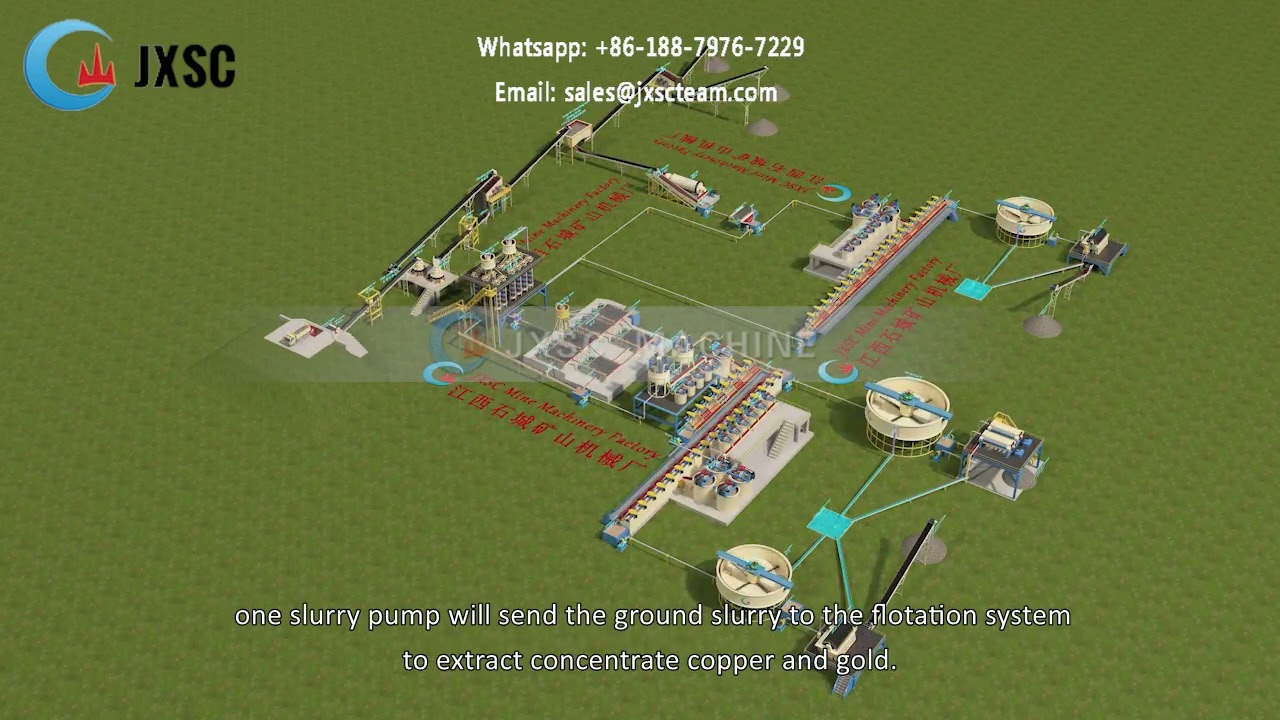
Copper flotation process is the most technologically mature method for enriching copper minerals, primarily separating copper ore from gangue based on differences in the hydrophobicity of mineral surfaces. JXSC, a leading global manufacturer of mineral processing equipment, provides customized, end-to-end copper flotation solutions, encompassing process design, equipment manufacturing, and industrial production, covering the entire process from crushing, grinding, classifying, flotation, concentration, and dewatering. It can increase the copper grade of raw ore from 0.3%-3% to 25%-35%, with a recovery rate of 90%+.

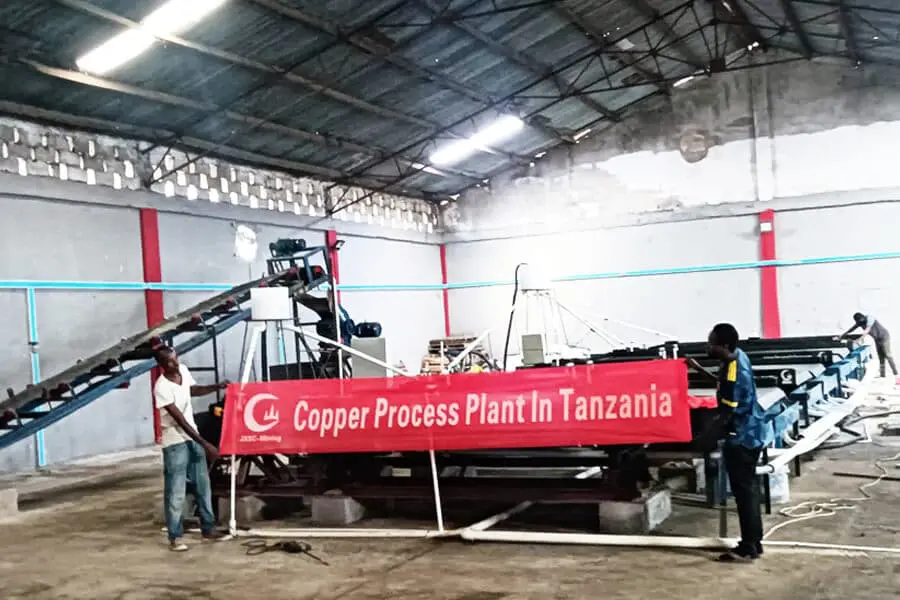
Compared to copper gravity separation processes, our froth flotation technology utilizes differences in mineral surface wettability to capture even micron-sized copper particles. It is particularly suitable for processing copper resources with fine-grained (0.002-0.3mm) and low grades, adaptable to different ore characteristics such as sulfide ores, oxide ores, and associated ores. This technology has been successfully applied in major copper-producing regions worldwide, including Zambia, Zimbabwe, South Africa, and Tanzania, etc.

3 Major Copper Flotation Processes

1. Sulfide Copper Flotation Process

About Copper Sulfide Ores:

Copper sulfide minerals, including chalcopyrite, chalcocite, and bornite, are the most floatable type of copper ore. With relatively uniform particle size, low mud content, and few impurities, it is currently the easiest type of copper ore to select and the most widely used.

500TPD Copper Sulfide Flotation Plant

Process: Crushing and screening → Grinding and classification → Flotation (roughing/cleaning/scavenging) → Concentration and dewatering.

Main equipment: vibrating feeder, primary jaw crusher, cone crusher, vibrating screen, belt conveyor, small vibrating feeder, ball mill, spiral classifier, mixing tank, flotation machine, mud pump, thickener, disc vacuum filter.

500TPD Sulfide Copper Flotation Process
Main Flow:

1. Feeding, Crushing, and Screening System: Operating 10 hours per day, feed capacity 50 tons/hour.

A vibrating feeder stably and evenly conveys raw materials (particle size less than 300-500 mm) to the primary jaw crusher for initial crushing, then to a cone crusher for secondary crushing. Subsequently, the finely crushed material is directly fed to a vibrating screen (two-layer screen, 20mm and 40mm aperture).

Materials larger than 20mm are returned to the cone crusher for further crushing; all fine materials conforming to the 0-20mm particle size are fed into the intermediate hopper before the ball mill.

2. Grinding System: Operating 24 hours a day, feed capacity 21 tons/hour.

Powdered materials of 0-20mm in the hopper are smoothly conveyed to the ball mill via an electromagnetic vibrating feeder. To obtain fine powder particles below 200 mesh, the ball mill needs to be used in conjunction with a spiral classifier to form a closed-loop circulation. The overflow from the classifier is a fine slurry of approximately 200 mesh; coarse particles in the underflow are returned to the ball mill for further grinding until the compliant flotation slurry particle size is achieved.

3. Flotation System:

The 200-mesh slurry is first fed into a mixing tank for thorough mixing with the material and relevant chemical reagents. The flotation process includes roughing, scanning flotation, and cleaning flotation. The number of sluices in the flotation machine is adjusted according to the grade of the copper ore.

4. Concentrate Dewatering System:

The copper concentrate slurry obtained from the flotation system contains moisture and has a very fine particle size (200 mesh). A thickener is used for preliminary concentration to increase its density, followed by dewatering using a disc vacuum filter. The copper concentrate with extremely low moisture content is then dried and sent to the packaging system. Furthermore, the water treated by the thickener and vacuum filter can be recycled for subsequent processes.

Note: This 500TPD copper sulfide flotation plant has a high copper concentrate recovery rate, with a post-treatment grade reaching up to 30-35%. This unit is also suitable for daily processing capacities of 1000 tons, 240 tons, and 120 tons. However, it does not include a tailings dewatering system; if needed, we can design and upgrade it for you.

2. Oxide Copper Flotation Process

About Copper Oxide Ores:

Copper oxides include malachite, azurite, and chrysocolla, and are black oxides of copper. They are finely and unevenly distributed and exhibit significant modification. It is mainly concentrated in Africa and Southeast Asia, and is characterized by poor floatability, belonging to the category of difficult-to-process copper ore.

24TPH Copper Oxide Ore Flotation Plant

Process: Crushing → Grinding and Classification → Flotation → Concentrate + Tailings Dewatering System

Core Equipment: vibrating feeder, jaw crusher (coarse), jaw crusher (fine), vibrating screen, ball mill, spiral classifier, flotation machine, concentrate dewatering system, tailings dewatering system.

240TPH Oxide Copper Flotation Process
Main Flow:

1. Crushing: Raw ore is fed into the raw material silo. A vibrating feeder under the silo evenly conveys the ore to a jaw crusher, crushing large pieces of ore to approximately 80mm in diameter. The coarsely crushed ore is then conveyed to a jaw crusher for further crushing to approximately 20mm in diameter. The finely crushed output is fed to a vibrating screen; unqualified material is returned for regrinding.

2. Grinding: An electromagnetic vibrating feeder under the transfer silo evenly conveys material with a diameter of 0-20mm into a ball mill. The slurry discharged from the ball mill is sent to a spiral classifier. Coarse particles are returned to the ball mill for further grinding, while material meeting the 200-mesh requirement is sent to a mixing tank.

3. Flotation: Reagents are added to the slurry in the mixing tank and then pumped into a flotation machine. The flotation system includes three processes: roughing, scavenging, and cleaning.

4. Concentration and Dewatering: After flotation, the screened copper concentrate is sent to a thickener for sedimentation. The concentrated concentrate underflow is pumped by a high-pressure pump into a disc vacuum filter to obtain dry copper concentrate that can be directly transported. The remaining tailings are sent to another thickener for processing, and the underflow is pumped into a plate and frame filter press to obtain dry tailings that can be directly transported. Furthermore, all overflow water from the thickener is recycled and reused.

Note: The system employs a closed-loop crushing and staged grinding design, ensuring stable particle size control and high precision in three-stage flotation separation. Production wastewater is fully recycled, resulting in strong environmental friendliness, low overall operating costs, and suitability for large-scale beneficiation of copper oxide ore.

3. Associated Copper Flotation Process

About Associated Copper Ores:

Associated copper ores often occur alongside valuable minerals such as gold, silver, molybdenum, lead-zinc, and iron. The copper grade is generally low, mostly between 0.5% and 1.5%, but the value of associated elements often exceeds that of the copper itself. Different minerals have significantly different floatability, and a single flotation process can easily lead to resource waste. Therefore, the core of process design is to achieve simultaneous recovery of multiple metals to maximize resource value.


Mixed copper ore flotation Solutions

2 Videos
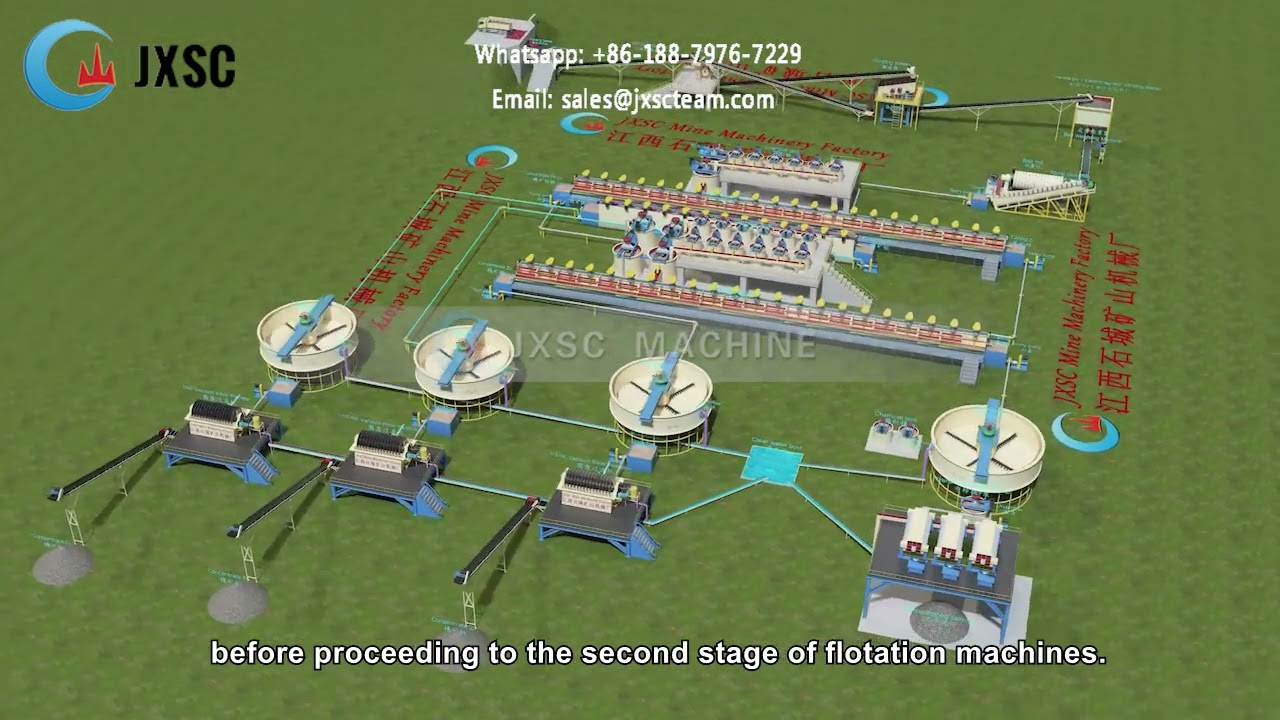
Details:

720TPD Sulfide Copper-Lead-Zinc Flotation Process

  • Crushing (Capacity 60-70 TPH): Closed-circuit screening using a jaw crusher and cone crusher; material ≤20mm is fed into the grinding stage.
  • Grinding (30 TPH): Ball mill paired with a spiral classifier; 70%-80% of the material is ground to 200 mesh and then sent to flotation.
  • Flotation (30 TPH): Three-stage flotation sequentially extracts a mixed copper-lead concentrate, separates copper and lead, and extracts a zinc concentrate.
  • Dewatering: The concentrate is dried to obtain the finished product; the tailings are dewatered and reused.

In addition to using flotation processes to extract concentrates from fine-grained copper sulfide, copper oxide, and associated copper ores, gravity separation (such as shaking tables and spiral sluices) can be attempted for large-particle ores, offering energy savings and low costs. For high-purity finished products, JXSC also provides full-chain copper processing solutions, including leaching and electrolysis, efficiently recovering copper from low-grade ores or tailings. 

Custom Copper flotation process solution

Design Your Flotation Plant Solution In 4 Steps:

(1) <Ore Property Analysis>:

A full set of process mineralogical tests is conducted on ore samples, including mineral composition, grain size, oxidation rate, and valuable element content, to clarify the boundaries of beneficiation.

(2) <Benefiting Tests>:

Small-scale laboratory flotation tests are then conducted to determine the optimal grinding fineness, reagent system, flotation process, and key indicators such as expected recovery rate and concentrate grade.

(3) <Process and Equipment Matching>:

Professional engineers design a complete set of wear-resistant crushing, grinding, flotation, and dewatering equipment based on your mine’s daily processing capacity, investment budget, and environmental requirements. Optimized layout reduces civil engineering costs, helping you choose the most cost-effective solution.

(4) <Installation, Commissioning, and Trial Production Optimization>:

After equipment delivery, our on-site engineering team will be responsible for on-site commissioning, operation, and maintenance training to ensure that production meets standards immediately upon commissioning. Regular follow-up process optimization will be provided afterward.

Why Choose JXSC Copper flotation process

40+ years of experience

Serving 1000+ mines worldwide, our mature technology has been market-proven, and our equipment is durable, low maintenance costs.

90%+ high recovery rate

Optimized reagent formulation reduces copper loss. Copper recovery rates are generally 5%-10% higher than the industry average.

Self-produced

Wear-resistant parts for core flotation machines and grinding equipment are made of high-chromium alloy, increasing service life by 30%, reducing failure rate and minimizing downtime losses.

One-stop service

From lab mineral sample testing and process design to later commissioning, operation & maintenance guidance, making us a cost-effective choice for various copper processing projects.

Intelligent control

Automated dosing system reduces human error. Engineers can remotely monitor equipment operation status in real time, providing early warnings of potential faults and maximizing production continuity for customers.

Environmentally friendly

A closed-loop water system can be used, reducing reagent usage by more than 30% compared to traditional processes, significantly lowering the risk of environmental pollution. Operating noise is controlled below 75 decibels.

Copper Plant Project: Successful cases

Maximize Your Copper Mine Profit

We understand that every mine is unique, and JXSC’s experienced engineering team will tailor the most suitable copper flotation process and equipment configuration solution for our clients based on factors such as ore characteristics, site conditions, and budget requirements. This includes process designs for different copper ore types with varying grades, oxidation rates, and associated components, such as porphyry copper mines, sedimentary copper mines, sandstone copper mines, copper-molybdenum polymetallic mines, and high-sulfur copper-gold mines.

In addition to the flotation process (fine-grained copper ore), we also provide other copper beneficiation solutions, including washing, screening, crushing, grinding, gravity separation (large-particle copper ores), magnetic separation, leaching, and electrolysis. Our services cover large, medium, and small copper mine projects with processing capacities ranging from 100T/D to 1000T/D, adaptable to the environmental, power, and operational requirements of regions such as South America, Africa, and Southeast Asia. Through process simplification, reagent optimization, and energy-saving equipment configuration, our aim is to maximize the utilization rate of copper and associated gold, silver, and molybdenum resources, reduce tailings metal loss, and improve the overall return on investment for the project.

Contact Us Now

Ask us about mineral processing configuration and equipment quote! (No job, No investment)

Notice:

  • We only provide mineral processing equipment and solutions; not buy and sell minerals/ ores/ materials.
  • We do not recruit, don’t offer jobs, no rental/ leases, and are not interested in investments or partnerships.
  • We value your privacy and keep your information safe.
Scroll to Top

Contact Us

Please fill in the mineral process solutions & equipment you need!

(No job, No work/ Not buy or sell minerals/ No investment, cooperation)