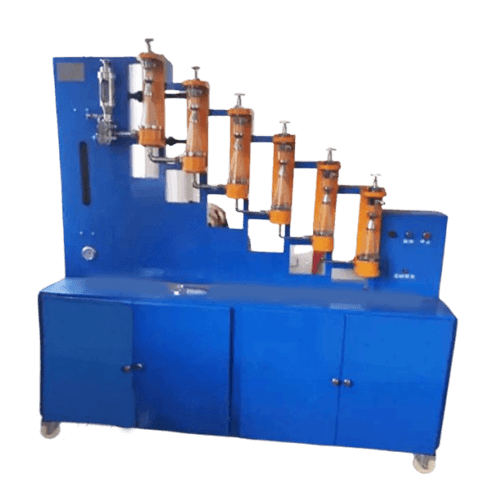
BXF Cyclone Particle Size Analyzer
- Feed Particle Size: < 74 μm
- Feed Quantity: < 100g/per time
- Analysis Time: 5–30 minutes
- Applications: The BXF cyclone particle size analyzer is primarily utilized in fields such as mining, geology, water conservancy, coal, chemical engineering, and building materials. It enables the rapid determination of the particle size distribution of various materials finer than 74 μm, and can also be employed for the continuous classification of ultrafine powder materials.
Products display


Introduction Of BXF Cyclone Particle Size Analyzer
The BXF cyclone particle size analyzer, also known as a cyclosizer, is an instrument designed to determine the particle size distribution of materials smaller than 0.074 mm in the mining and mineral processing industries. By using multi-stage (5-8 units) hydrocyclone separation units to establish a continuous classification pathway, this device offers a superior alternative to traditional gravity sedimentation, enabling the sequential classification of particles from 1 to 100 microns by size. It is particularly well-suited for the analysis of high-concentration, viscous, or easily agglomerating samples. Applications include, but are not limited to, pyrite, chalcopyrite, galena, sphalerite, cassiterite, iron ore, gold ore, tailings classification, flotation circuits, silica filter media, chalk powder, clay, and soil; as well as manufactured chemicals such as alumina, lead sulfate, lead oxide, zinc powder, zinc oxide, silicon carbide, fly ash, magnetite, and ferrosilicon.
Compared to traditional sieving methods and laser particle size analyzers, the Cyclosizer offers superior repeatability and stability. It enables real-time monitoring of particle size distribution within continuous production processes, thereby enhancing product consistency and operational efficiency. By precisely adjusting the flow rate and the inclination angle of the cyclones, the cut-off particle size can be accurately controlled; when configured in a multi-stage cascade, the system yields a complete particle size distribution curve. Featuring a modular design that ensures ease of operation and low maintenance costs, the BXF cyclone particle size analyzer stands as the preferred solution for the particle size analysis of solid materials in both laboratory settings and small-scale mineral processing pilot studies.
Application Scenarios
- Mineral processing industry: Used for particle size detection after ore crushing and grinding, and to optimize the classification process.
- Metal powder manufacturing: controlling the uniformity of metal powder particle size to improve the quality of 3D printing and powder metallurgy.
- Chemical materials: Testing the particle distribution of catalysts, ceramic powders, and pigments to ensure product stability.
- Environmental engineering: Analyzes the size of flocculated particles in wastewater treatment, optimizing sedimentation performance.
- Scientific research & laboratories: Provides precise particle size data for research fields such as materials science and geology.
principle & structure Of BXF Cyclone Particle Size Analyzer
Working Principle
The BXF cyclone particle size classifier achieves particle classification by balancing centrifugal force and fluid drag. Upon being pumped into the cyclone chamber, the sample slurry generates a strong centrifugal field through high-speed rotation; larger particles are thrown toward the chamber walls by inertia and settle into a collection tank, while smaller particles are carried upward by the rising flow, overflowing from the top and being conveyed to the next stage of the cyclone system. By arranging multiple sets of cyclone tubes in series—each with a progressively smaller inner diameter—the classification threshold is gradually lowered, ultimately enabling the precise separation of mineral particles within specific size ranges into their corresponding cyclone units. Finally, by separately collecting the underflow and overflow products from each stage, a complete particle size distribution profile can be obtained.

Structural Features
- Hydrocyclone assembly: The core grading unit, typically consisting of 5-8 hydrocyclone chambers with different apertures connected in series.
- Feeding system: including a peristaltic pump and flow stabilizing valve, to ensure a constant sample flow rate.
- Collection device: Particle receiving tanks corresponding to each stage of the hydrocyclone, with graduated markings.
Control system: Digital panel for adjusting speed, timing, and pressure parameters. - Support Structure and Interfaces: Features a modular design to facilitate easy disassembly for cleaning and the expansion of classification stages.
why choose JXSC BXF Cyclone Particle Size Analyzer
features & Advantages
√ High-precision classification: Measurement results closely mirror actual particle behavior; notably, the error rate (±5%) for irregular particles (such as flaky or fibrous materials) is significantly lower than that of laser diffraction methods.
√ Wide dynamic range: Covers the full spectrum from 1 to 100 microns, making it suitable for operation in harsh environments characterized by high temperatures, high humidity, and heavy dust.
√ Low maintenance costs: The core classification unit contains no rotating parts or precision optical components; the only consumable requiring replacement is the hydrocyclone liner.
√ Simple operation: The analysis cycle is shortened to under 30 minutes; no complex specialized skills are required, allowing operators to begin work after only brief training.
√ Energy-efficient and durable: Power consumption is merely one-fifth that of laser-based equipment. The hydrocyclone liners—which come into direct contact with the material—are constructed from wear-resistant polyurethane, ensuring a service life of over three years.
√ Transparent and visual: The transparent hydrocyclone chamber allows for real-time observation of the particle separation process, enabling users to quickly assess the material’s particle size distribution.
√ Compact footprint: Featuring an integrated, all-in-one design, the unit can be placed directly on a standard laboratory bench or in a corner of a production workshop, requiring no additional infrastructure modifications.
√ Broad adaptability: By simply swapping hydrocyclone liners of different specifications, the classification size range can be flexibly adjusted to suit the material characteristics of various industries—including metal ores, non-metal ores, and chemical powders.
√ Robust data traceability: Automatically records key parameters—such as pressure, flow rate, and duration—for every test batch. Standardized test reports can be generated and exported, thereby meeting the requirements of laboratory quality management systems.
√ Environmentally Friendly: The fully enclosed piping design prevents slurry splashing and material loss. All classified products can be completely recovered for subsequent beneficiation tests, thereby preventing the loss of valuable samples.
models & specifications
Model | BXF |
Feeding Size | -74μm |
Feeding Capacity | Less than 100g per time |
Analysis Time | 5-30 minutues |
Particle Size Distribution | 74-53, 53-41, 41-30, 30-20, 20-10, 10-8, -8μm, based on quartz |
Error Range | ±5% |
Material Specific Gravity | More than 1.0 |
Motor Power | 0.75kw |
Weight | 550kg |
Dimension | 2000*2000*700mm |




Contact Us Now
Ask us about mineral processing configuration and equipment quote! (No job, No investment)
Notice:
☑ We only provide mineral processing equipment and beneficiation solutions.
☒ We do not recruit, don’t offer jobs, no rental/ leases, and are not interested in investments or partnerships. Not buy and sell minerals/ ores/ materials.
● We value your privacy and keep your information safe.