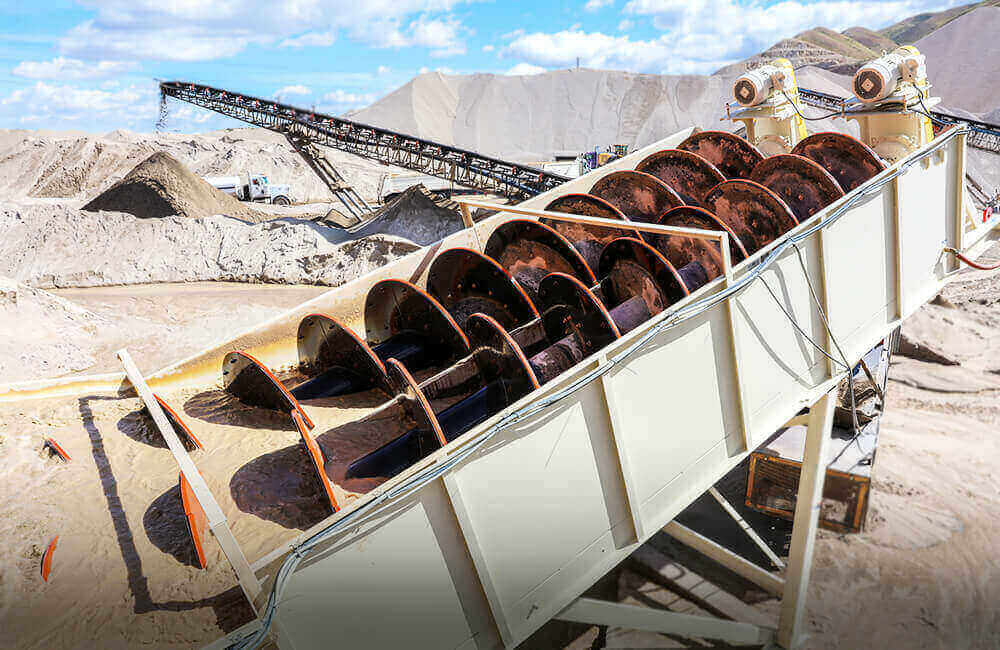
1TPH (12TPD) Stibnite Antimony Flotation Plant In Pakistan
We guarantee the high quality machine in the mineral processing industry, established in 40+ years of experience!

Project Info.
- Ore type: stibnite antimony ore
- Feed grade of raw ore: 25% to 40% grade
- Capacity: 1 TPH (ton per hour); 12TPD (tons per day)
- Max feeding size: 150mm
- Final antimony concentrate grade target: 60%+
- Location: Pakistan
Process
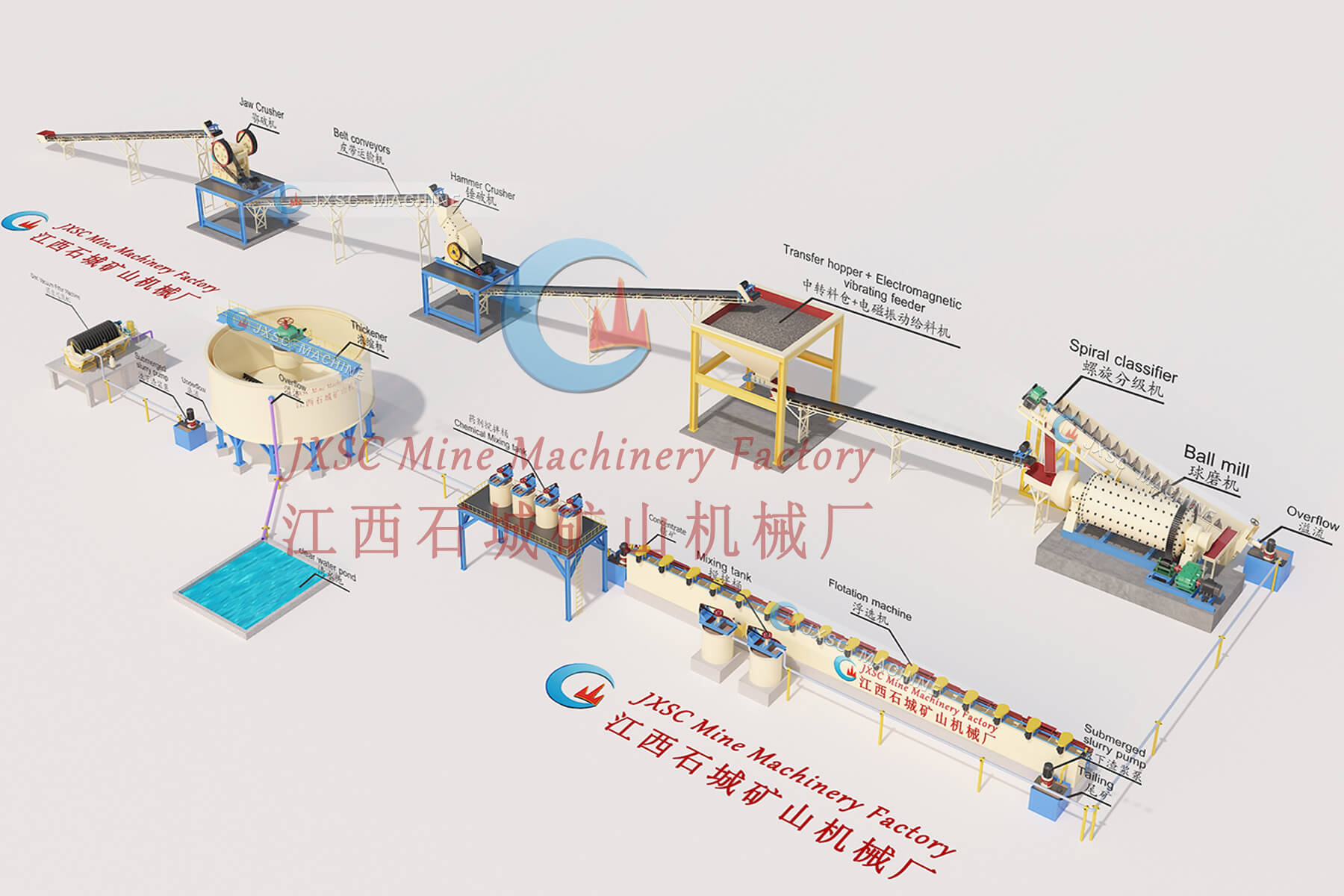
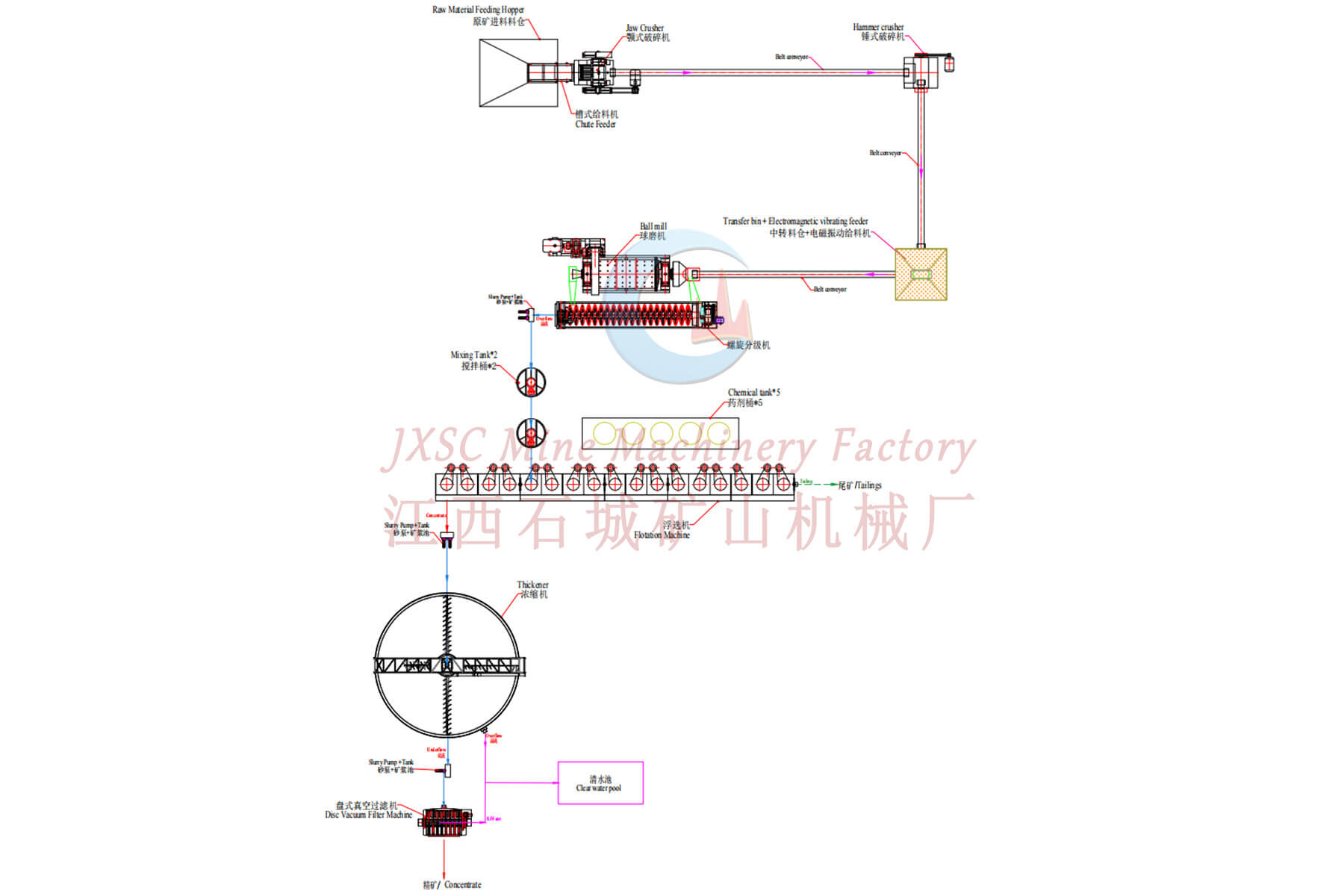
Feeding – Crushing – Grinding – Classification – Flotation – Concentration, Filtration, and dewatering
process flow
1TPH (12TPD) Stibnite Antimony Flotation Plant
This is a complete 1 ton/hour (approximately 12 tons/day) stibnite antimony flotation plant located in Pakistan. The customer’s raw ore grade is 25%~40%, and the main recovered mineral is stibnite (Sb2S3). The entire production line adopts a complete process route including feeding, crushing, grinding and classification, flotation, concentrate dewatering, and tailings treatment.
1TPH (12TPD) Stibnite Antimony Flotation Plant Flow Details
(1) Feeding and Crushing:
The system comprises a chute feeder, jaw crusher, hammer crusher, and belt conveyor. Raw ore with a maximum particle size of 150 mm is loaded into the hopper by an excavator or loader and then evenly fed into the jaw crusher through the chute feeder, where it is reduced to 0–50 mm. The crushed material is subsequently transported via belt conveyor to the hammer crusher for further size reduction to 0–10 mm and finally delivered to the transfer hopper.
Note: The customer requires that the raw ore feed particle size be controlled to less than 150 mm. The crushing system has a capacity of 2 tons per hour and operates for 10 hours per day. Customization is available upon request.
(2) Grinding and Classification:
A closed-loop grinding circuit consisting of a ball mill and a spiral classifier is employed. Fine ore (0–10 mm) is uniformly fed into the ball mill for grinding via an electromagnetic feeder and belt conveyor. The discharged material enters the spiral classifier for classification. The coarse particles (classifier return sand) are sent back to the ball mill for regrinding, while the overflow (fine particles of –200 mesh) is pumped to the mixing tank to ensure that the flotation feed particle size meets the required specifications.
(3) Mixing and Pulp Preparation:
The –200 mesh slurry is introduced into the mixing tank, where flotation reagents (including collectors, frothers, modifiers, etc.) are added and thoroughly mixed to prepare the pulp for flotation operations.
(4) Flotation:
The flotation system consists of a mixing tank and flotation machines. Its function is to produce high-grade antimony concentrate. The –200 mesh slurry from the spiral classifier is pumped to the mixing tank for slurry and reagent mixing. The conditioned slurry then proceeds to the flotation machine process, which is divided into roughing flotation, scavenging flotation, and cleaning flotation.
Based on the customer’s raw ore grade of 25%–40%, our engineer recommends the following flotation configuration:
- 1-stage roughing flotation: 5 flotation cells, model SF-0.37
- 2-stage scavenging flotation: 3 + 3 = 6 flotation cells, model SF-0.37
- 2-stage cleaning flotation: 3 + 2 = 5 flotation cells, model SF-0.37
After the flotation process, the customer can obtain antimony concentrate with a maximum grade of 60%+.
Note: The customer’s requirement for the grinding and flotation system is 1 ton per hour, operating for 20 hours per day. (Customization is available upon request.)
(5) Concentrate Dewatering:
The concentrate slurry from flotation is first thickened in a thickener to a concentration of 40%–45%. The overflow (clear water) from the thickener is recycled for production use, while the underflow is fed into a disc vacuum filter for dewatering, ultimately producing an antimony concentrate filter cake with an acceptable moisture content.
Note: The customer requires a filtration system for the final concentrate. (The design can be customized.)
(6) Tailings Treatment:
Flotation tailings are pumped to a tailings dam. The flotation reagents used are non-toxic and harmless. A small amount of lime may be added to the tailings to promote the settling of suspended solids and residual reagents, ensuring that the tailings remain environmentally friendly.
The successful commissioning of this 1TPH (12TPD) stibnite antimony flotation plant in Pakistan. The complete equipment is compact and highly automated, low-cost, ultimately obtaining antimony concentrate with a grade of 60%+, making it very suitable for small and medium-sized antimony ore processing projects.
It is important to note that the properties of antimony ore vary significantly between different mines. For example, different mineral types such as stibnite, antimony sulfide, and antimony ochre, as well as the composition and particle size of associated elements, will all affect the selection of beneficiation processes and reagent regimes. Therefore, JXSC strongly recommends that clients conduct ore beneficiation tests (mineral processing tests) before investment. Contact us for a customized complete antimony ore beneficiation solution design and equipment quotation!
Process Site


Highlight Of JXSC Design 1TPH (12TPD) Stibnite Antimony Flotation Plant
√ Low investment, quick returns: The 1 TPH scale is specifically designed for small and medium-sized antimony mines, featuring compact equipment, low infrastructure investment, and a short investment payback period.
√ High recovery rate: Utilizing classic flotation technology, the multi-stage process of roughing, scavenging, and cleaning demonstrates extremely high adaptability and recovery rate for antimony sulfide ores such as stibnite.
√High concentrate grade: After flotation, 25%~40% of the raw ore can be stably converted into antimony concentrate with a grade of over 60%, resulting in high product value.
√ Reasonable equipment configuration: The entire process—crushing, grinding, flotation, and dewatering—is interconnected, highly automated, and easy to operate and maintain.
√ Water resource recycling: Thickener overflow water is recycled for production, saving water costs.
√ Environmental compliance: An optional tailings dry discharge system can be added to reduce environmental pollution and meet the requirements for green mine construction.
Main Equipment
Equipment List For 1TPH (12TPD) Stibnite Antimony Flotation Plant
| No. | Name | Model | Quantity (set) |
|---|---|---|---|
| 1 | Electromagnetic Vibrating Feeder | GZ5 | 1 |
| 2 | Jaw Crusher | PE150×250 | 1 |
| 3 | Hammer Crusher | PC-400×300 | 1 |
| 4 | Belt Conveyor | B500×10m | 3 |
| 5 | Hopper | / | 2 |
| 6 | Electromagnetic Vibrating Feeder | GZ1 | 1 |
| 7 | Ball Mill | 0918 | 1 |
| 8 | Steel Balls | / | 2 tons |
| 9 | Spiral Classifier | FG-5 | 1 |
| 10 | Slurry Mixing Tank | XB800 | 2 |
| 11 | Chemical Mixing Tank | XB750 | 4 |
| 12 | Flotation Machine | SF-0.37 | 16 |
| 13 | Thickener | NZS3.6 | 1 |
| 14 | Disc Vacuum Filter | PGT6-2 | 1 |
| 15 | Submerged Slurry Pump | 40QV-SPR | 5 |
| 16 | Electric Control Cabinet | Controls the start and stop of the plant equipment. Complete set of electric control panels for all machines. | 1 |
Contact Us Now
Ask us about mineral processing configuration and equipment quote! (No job, No investment)
Notice:
☑ We only provide mineral processing equipment and beneficiation solutions.
☒ We do not recruit, don’t offer jobs, no rental/ leases, and are not interested in investments or partnerships. Not buy and sell minerals/ ores/ materials.
● We value your privacy and keep your information safe.