JXSC Machinery

Stacked Vibrating Fine Screen

Stacked Vibrating Fine Screen

  • Screen decks: 1, 2, 3, 5
  • Feed density: 30–40%
  • Lateral slope: 20°
  • Application: Stacked vibrating fine screens are widely used in mineral processing plants for iron ore, ilmenite, tungsten, tin, tantalum, and niobium, as well as in coal preparation plants for coal slime recovery, coarse/fine coal classification, and dewatering operations. They are also utilized in quartz sand, feldspar, and kaolin processing plants to control final product particle size and for wet fine screening and classification of materials such as fluorite, phosphate rock, and lithium ore.

Products display

Introduction Of Stacked Vibrating Fine Screen

The stacked vibrating fine screen is a compact, high-efficiency, tiered screening equipment specifically designed for the wet screening and classification of fine-grained materials; it is also known as a stack sizer or multi-deck high-frequency vibrating fine screen. Its core feature lies in the use of vertically stacked screen decks (typically 1, 2, 3, or 5 layers) to achieve multi-stage screening within a compact footprint, thereby significantly enhancing processing capacity and precision. The stack sizer is capable of achieving separation sizes as fine as 0.074 mm (200 mesh) with screening efficiency 90%+. It is widely used in mineral processing plants, such as those for iron, tungsten, tin, tantalum-niobium, and coal, as well as in tailings recovery operations for concentrate size control and classification. In mineral processing circuits, the stacked vibrating fine screen often replaces spiral classifiers or hydrocyclones, resulting in a 10%–20% increase in both grinding system throughput and recovery rates.

Compared to common vibrating screens, the 3- or 5-deck stacked frame assembly is driven by a single high-frequency vibration source, effectively multiplying the screening area while ensuring uniform force distribution across the decks. Additionally, the equipment utilizes wear-resistant polyurethane screen panels featuring high open-area ratios and anti-clogging properties, which further extends the unit’s service life. Based on the core design concept of “multi-layer stacking and parallel processing,” the stacked vibrating fine screen is particularly well-suited for applications requiring high screening precision and a compact equipment footprint.

principle & structure Of Stacked Vibrating Fine Screen

Working Principle

The stacked vibrating fine screen is driven by two electric vibrators rotating in opposite directions, causing the screen frame to undergo linear motion. The resultant force exerted by the two vibrators passes through the center of gravity of the screen frame, ensuring uniform excitation force across all points of the frame. Slurry is evenly distributed into multiple streams by a splitter and fed onto the upper section of the screen surface by a feed distributor. Subjected to high-frequency, low-amplitude vibration, the material continuously bounces along the inclined screen surface; fine particles pass through the apertures to become the undersize product, while coarse particles bounce along the surface and are discharged as the oversize product. The screen box remains stationary, with only the screen surface itself vibrating.

Structure Of Stacked Vibrating Fine Screen
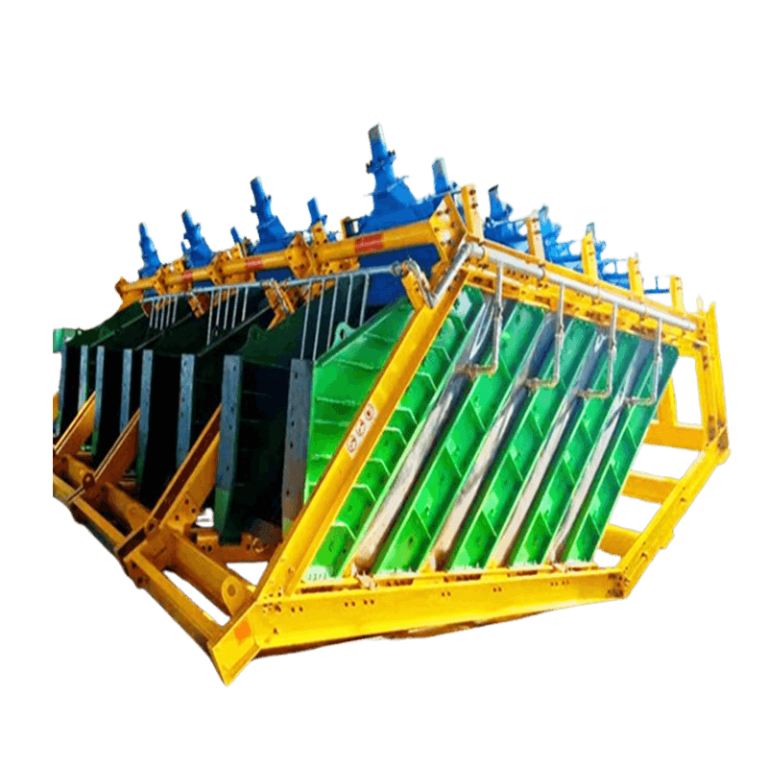
Stacked Vibrating Fine Screen

Structural Features

  • Multi-layer screen boxes: Vertically stacked screen frames, with each layer operating independently.
  • Vibration motors: Two vibratory motors arranged in counter-rotation to provide a high-frequency vibration source, ensuring material fluidity.
  • Feed distributor and feeder: Evenly distribute slurry to each layer, ensuring uniform material spread across the screen surfaces.
  • Elastic support system: Absorbs vibration and stabilizes the operation of the screen body.
  • Under-size/Over-size collection hoppers: Collect under-size and over-size materials from each layer, respectively for centralized discharge.
  • Polyurethane screen panels: High open area (31%–45%) and inverted-triangle anti-clogging design; average service life exceeds 6 months.
  • Support frame: Integrated steel structure with an anti-corrosive and wear-resistant coating.
  • Anti-clogging design: Options such as bouncing balls or ultrasonic cleaning devices.

why choose JXSC Stacked Vibrating Fine Screen

features & Advantages

Ultra-high screening efficiency: Multi-layer screening surfaces operate simultaneously, achieving efficiencies exceeding 90% with classification precision far superior to single-deck screens.

High processing capacity: The 3- to 5-deck stacked configuration exponentially increases the screening area, significantly boosting throughput.

Small footprint: The vertical stacking design allows for up to five parallel connections, significantly saving space compared to multiple screening machines.

Low power consumption: The stack sizer has extremely low overall power consumption and low operating costs, making it a typical energy-saving screening device.

Low noise: Rubber spring suspension minimizes vibration and dynamic loads, requiring no special installation provisions.

Strong adaptability: Capable of processing moist, sticky, fine-grained materials (anti-blinding technology available as an option).

Long screen lifespan: Forced feeding reduces slurry flow velocity; the polyurethane screens are wear-resistant, vibration-tolerant, and designed to prevent blinding.

Fine separation size: Effective separation down to 0.075 mm, meeting requirements for fine and ultra-fine particle classification.

Self-cleaning and non-clogging: High-frequency vibration combined with a dual-amplitude design ensures high intensity and excellent self-cleaning capabilities, resulting in minimal screen blinding.

Variable-frequency control: Customizable screen apertures and adjustable vibration frequencies enable flexible adaptation to various material characteristics and particle-size requirements.
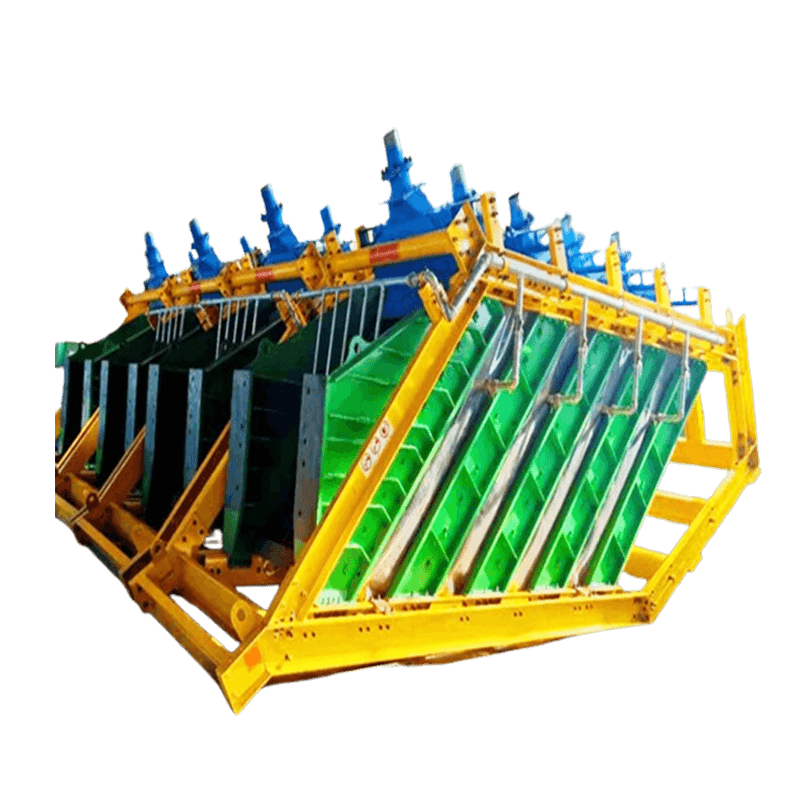
models & specifications

Model1216-11216-21216-31216-5
Screening Size (m²)1.923.845.769.6
Layer1235
Vibration Amplitude (mm)1.33-2.611.33-2.611.33-2.611.33-2.61
Feeding Density (%)30-4030-4030-4030-40
Motor Power (kw)2.2kw*22.2kw*22.2kw*22.2kw*2
Rotating speed (r.p.m)1500150015001500
Lateral Slope20°20°20°20°
Polyurethane Screen Mesh (Sieve size is optional)0.075mm, 0.1mm, 0.125mm, 0.15mm, 0.18mm, 0.2mm, 0.3mm, 0.425mm, 0.5mm, 0.6mm
Contact Us Now

Ask us about mineral processing configuration and equipment quote! (No job, No investment)

Notice:

We only provide mineral processing equipment and beneficiation solutions.

We do not recruit, don’t offer jobs, no rental/ leases, and are not interested in investments or partnerships. Not buy and sell minerals/ ores/ materials.

We value your privacy and keep your information safe.

Scroll to Top