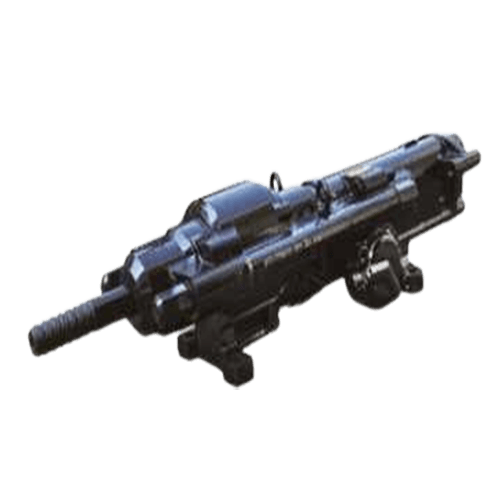
Hydraulic Rock Drilling Machine
- Drilling diameter: 33–76 mm
- Impact frequency: 45–60 Hz
- Impact power: 20 kW
- Drilling range: 38–76 mm
- Application: Hydraulic rock drills are widely used in scenarios involving high-hardness rock formations or heavy-duty drilling requirements. These include metal and non-metal mining, underground coal mine roadway development, quarry blasting, tunnel and railway/highway construction, slope and tunnel anchoring/support, as well as municipal and hydroelectric foundation engineering.
Products display


Introduction Of Hydraulic Rock Drilling Machine
A hydraulic rock drilling machine (hydraulic rock splitter, hydraulic rock breaker) is a piece of rock-drilling equipment that uses high-pressure hydraulic fluid as its power medium, converting hydraulic pressure into high-frequency impact energy and rotational torque. Through the high-speed reciprocating motion of an internal piston, it delivers continuous strikes to the shank of the drill rod, while simultaneously applying rotation and feed force to the drill bit. These combined actions enable rock drilling, splitting, and fragmentation. Its high impact energy can effectively break high compressive strength rock layers, such as maintaining a stable penetration rate in hard strata like granite and basalt. It is particularly well-suited for medium-to-deep hole drilling, covering a hole diameter range of 38–76 mm.
Furthermore, hydraulic rock drilling machines are characterized by high impact force, rapid drilling speeds, and superior energy efficiency. They are also energy-saving, environmentally clean, and safe to operate, making them the primary rock-drilling equipment used in modern mining, tunneling, and large-scale geotechnical engineering projects. For operations involving long-term, continuous, and high-volume drilling in particular, hydraulic rock drilling machines offer a compelling cost-performance advantage, typically resulting in a short payback period for the initial investment.
Compared to conventional pneumatic rock drills:
Although hydraulic rock drills have a higher initial purchase cost, their overall operating costs are often lower. Because they do not require large air compressors, energy consumption can be reduced by more than half; meanwhile, drilling speeds increase manifold, ultimately lowering the cost of drilling operations.
Core Application Scenarios:
- Underground metal and coal mine roadway excavation: Drilling of cut holes, perimeter holes, and gas drainage holes; particularly well-suited for rapid drilling in hard rock formations.
- Open-pit mining and quarrying: Drilling of various blast holes to facilitate large-scale, efficient extraction.
- Tunneling projects: Rock excavation and support drilling for railway and highway tunnels.
- Construction: Rock foundation reinforcement and blast hole drilling for reservoirs and dams.
- Municipal and hydropower infrastructure: Drilling in confined spaces, such as for pile foundation holes or dam foundation treatment.
principle & structure Of Hydraulic Rock Drilling Machine
Working Principle
The operation of a hydraulic rock drill can be summarized as a synergistic, four-fold process: impacting, rotating, feeding, and flushing. First, the reversing valve precisely switches between high- and low-pressure oil chambers according to the piston position, driving the piston to reciprocate continuously in the cylinder; at the end of the stroke, it strikes the drill bit at high speed, generating a compressive stress wave that propagates along the drill rod and reaches the bottom of the hole to break the rock. Simultaneously, a hydraulic motor rotates the drill string, ensuring that each impact point consistently strikes fresh rock. Meanwhile, a feed cylinder applies a steady, forward thrust, while high-pressure flushing removes rock cuttings; the coordination of these actions enables continuous, highly efficient drilling.

Structural Features
- Impact piston and cylinder: generate high-frequency impact, which is the source of rock-breaking energy.
- Flow control valve: switches the oil circuit according to the timing sequence to control the impact frequency.
- Rotary hydraulic motor: drives and controls the rotation of the drill rod.
- Energy storage voltage regulator: Suppresses pulsations and stabilizes system pressure output.
- Buffer damping device: absorbs reflected waves and reduces fatigue of machine parts.
- Drill rod and drill bit: made of alloy steel, in direct contact with the rock formation.
- Control system: Adjusts impact frequency, pressure, and rotation speed.
why choose JXSC Hydraulic Rock Drilling Machine
features & Advantages
- Strong rock-breaking ability: The large impact energy strikes the rock surface directly, and the penetration rate in high-hardness rock layers such as granite and quartzite is significantly better than rotary and pneumatic drilling.
- High efficiency and energy saving: Hydraulic transmission reduces energy loss, and the drilling speed is more than 30% faster than pneumatic equipment.
- Low noise and environmentally friendly: The operating noise and dust emissions are far lower than those of pneumatic equipment, effectively improving the working environment.
- Safe and reliable operation: Mostly using mechanized trolleys or remote control operation, operators are kept away from the working face to avoid the risks of falling rocks and silicosis.
- Precisely adjustable parameters: Impact energy, frequency, and rotation speed can be independently and steplessly adjusted to flexibly match different rock types and ensure hole formation quality.
- Versatile rock adaptability: Capable of drilling through hard, dense rock, while also maintaining stable performance in fractured or alternating hard-and-soft strata, with excellent resistance to drill-rod jamming.
- Reliability and durability: Buffer damping and high-quality sealing structure resist reflected impacts, reduce component fatigue, and extend the service life of the whole machine and drilling tools.
- High potential for intelligentization: It is easy to connect to modules such as automatic drilling, anti-jamming, and remote monitoring, and supports data-driven management of the drilling process.
models & specifications
Item | Data |
Rod tail | R32, R38, T38 |
Distance from machine top to machine center | 88 mm |
Impact power | 20 kW |
Impact frequency | 45–60 Hz |
Drilling range | 38–76 mm |
Max. Impact power (kW) | 18 |
Max. Impact pressure (Bar) | 230 |
Displacement (Standard) | 160 |
Life of impact piston (Linear meter) | ≥3000 |
Overall dimensions (L×W×H) | 1215 × 255 × 223 mm |
Weight | 170 kg |
Drilling diameter | 33–76 mm |
Flow rate | 75–95 L/min |
Impact energy | 300 J |
Displacement (Standard) | 160 CC |
Max. torque | 800 N·m |
Rotation flow rate | 75 L/min |
Max. inlet air pressure | 210 bar |
Rotation speed | 0–340 rpm |
Lubrication air flow | 5 L/s |
Lubrication air pressure | 2 bar |
Water pressure | 25 bar |
Water flow rate | 40–120 L/min |
Noise | ≤106 dB |
First maintenance time for wearing parts | ≥400 h |
Life of impact piston | ≥3000 linear meters |
Packaging dimensions | 1235 × 345 × 395 mm |
Gross weight | 183.7 kg |
Application | Used for rock drilling and medium- and deep-hole drilling. The drilling range is 38–76 mm. |




Contact Us Now
Ask us about mineral processing configuration and equipment quote! (No job, No investment)
Notice:
☑ We only provide mineral processing equipment and beneficiation solutions.
☒ We do not recruit, don’t offer jobs, no rental/ leases, and are not interested in investments or partnerships. Not buy and sell minerals/ ores/ materials.
● We value your privacy and keep your information safe.