Should you choose wet or dry magnetic separation? How can mining enterprises determine the most suitable magnetic separation process? In the field of mineral processing, wet magnetic separation utilizes water flow to separate magnetic minerals and is well-suited for fine-grained, weakly magnetic ores. Conversely, dry magnetic separation operates without water, employing high-gradient magnetic fields to efficiently process coarse-grained, strongly magnetic minerals. However, for the same batch of ore, if the wrong dry or wet route is chosen, the recovery rate may vary greatly, and this loss will continue to accumulate in production, rather than just remaining at the level of a one-time equipment investment. This article explores the core differences between wet and dry magnetic separation technologies, helping you precisely align your specific ore characteristics with the optimal separation strategy to enhance economic returns.
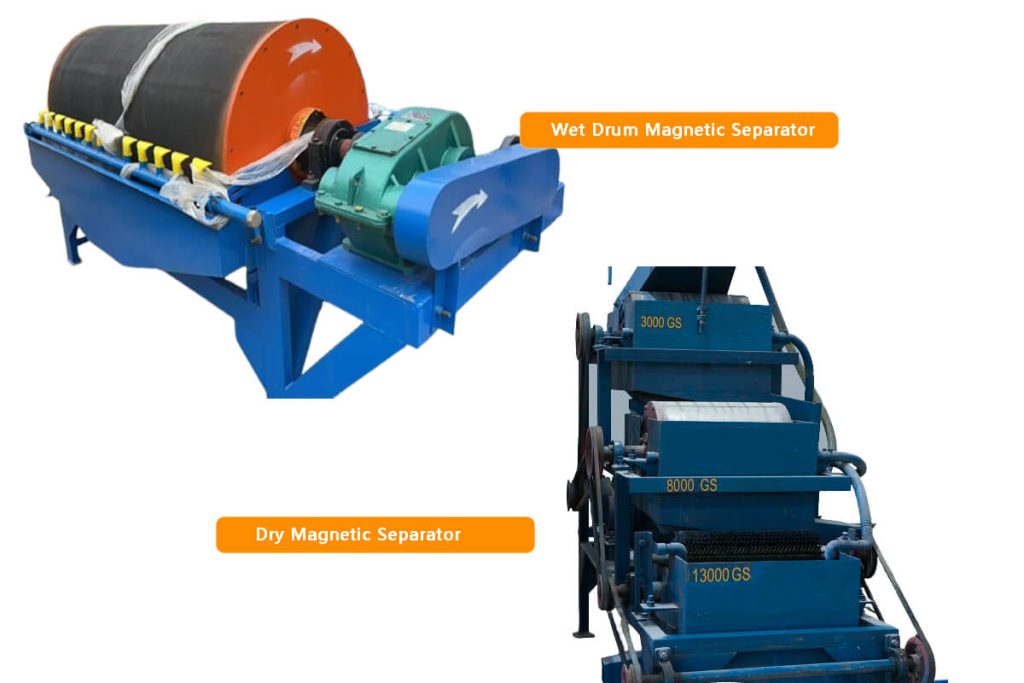
How should one choose between wet and dry magnetic separation? The key lies in matching the method to the ore’s characteristics! Generally, wet magnetic separation (assisted by water flow) is suitable for fine-grained (<3 mm) weakly magnetic minerals, achieving recovery rates of over 95%. Conversely, for coarse-grained, dry, or water-scarce mining operations, dry magnetic separation is appropriate for pre-concentration and the rejection of tailings—though this requires the inclusion of dust-removal systems.
What Magnetic Separation Actually Separates?
The Essence of Magnetic Separation:
Magnetic separation leverages differences in the magnetic susceptibility of minerals. For instance, magnetite is captured immediately upon entering the magnetic field, whereas quartz shows virtually no response. This process relies neither on chemical reagents nor on the color or density of the minerals. Whether dealing with hematite, columbite-tantalite, or manganese ore, as long as there is a difference in magnetic properties, the minerals can be precisely separated by adjusting the magnetic field strength. The distinction between “dry” and “wet” magnetic separation essentially refers to whether the particles are dispersed via mechanical airflow or through an aqueous medium.
The Functions of Magnetic Separation:
- Enriching Valuable Minerals: It upgrades low-grade raw ore into a “rough concentrate” suitable for subsequent processing stages. By discarding gangue (waste rock) at a coarse-particle stage, the volume of material entering the grinding circuit is reduced, thereby lowering the grinding load.
- Removing Harmful Impurities: In non-metallic minerals, iron contamination can negatively impact properties such as whiteness and electrical insulation. Magnetic separation effectively removes gangue minerals like quartz and feldspar, thereby increasing product purity.
- Separating Various Minerals: It is applicable to a wide range of magnetic minerals—such as those containing iron, manganese, or tungsten—with the magnetic field strength flexibly adjusted based on the specific characteristics of the minerals. Furthermore, equipment can be configured with multiple (2–4) layers of drums to enhance the recovery efficiency of polymetallic ores in a single pass.
- Recovering Valuable Components: Magnetic separation can be used to extract valuable elements from discarded tailings, thereby minimizing resource waste.
- Facilitating Downstream Processes: Magnetic separation is rarely used in isolation; it is frequently integrated with gravity separation, flotation, or electrical separation. Each stage targets a specific particle-size fraction, leading to a consistent improvement in overall recovery rates.
What is a wet magnetic separator?
(1) Principle
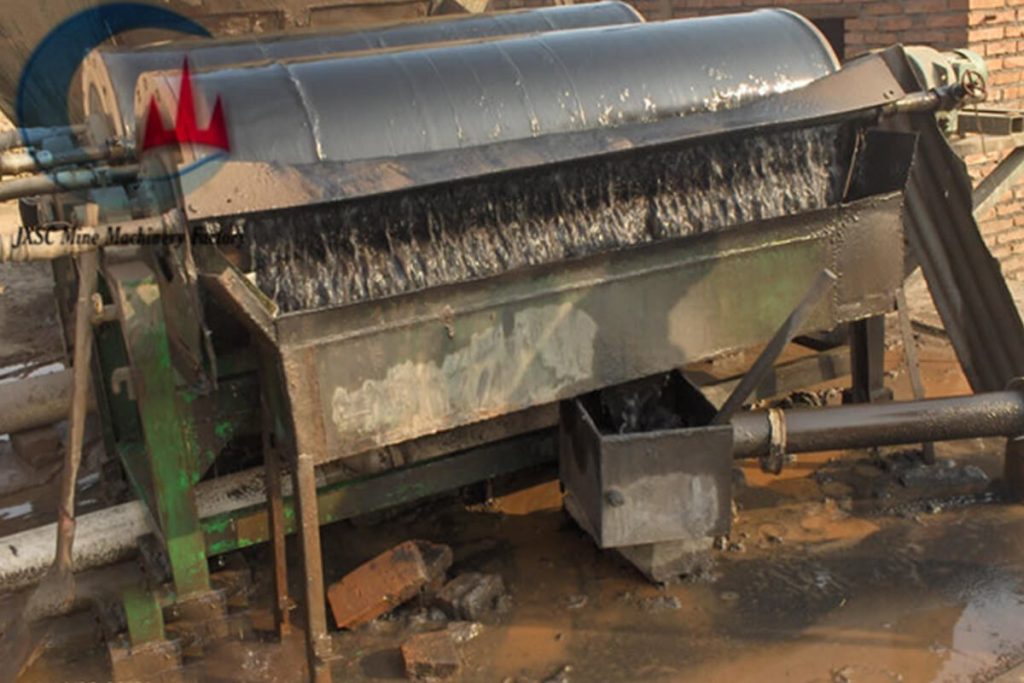
The ore is first mixed with water to form a slurry, which is then fed into the separation tank. Magnetic particles are attracted to the surface of a rotating drum and subsequently released once they reach a non-magnetic zone, while the gangue (waste material) is carried away by the water flow. The slurry medium facilitates the dispersion of particles, preventing fine particles from agglomerating and ensuring a cleaner separation interface compared to dry processing. The slurry concentration is typically maintained between 15% and 30%; if it is too dilute, throughput decreases, whereas if it is too dense, the magnetic field cannot effectively penetrate the material layer. Wash water is essential for determining the grade of the concentrate and should not be skimped on.
(2) Main Equipment Types
Permanent-magnet drum magnetic separators are the industry standard. Based on the design of the tank, they are categorized into three types: concurrent, semi-countercurrent, and countercurrent.
Concurrent separators are suitable for roughing, with a feed particle size capacity of up to 6 mm.
Semi-countercurrent separators are the most effective for the purification of fine particles.
Countercurrent separators are primarily used for roughing or scavenging operations.
Additionally, for processing weakly magnetic minerals, vertical-ring high-gradient or high-intensity wet magnetic separators are required.
(3) Applicable Ores
Magnetite and pyrrhotite, following fine grinding, are well-suited for wet processing.
Weakly magnetic minerals such as hematite, limonite, manganese ore, and ilmenite require strong wet magnetic separation equipment.
For non-metallic minerals, wet iron removal can improve the whiteness of materials such as quartz sand, potash feldspar, kaolin, and silica sand.
(4) Advantages
- Particles are well-dispersed within the slurry, leading to high recovery rates for fine particles and minimal fluctuations in concentrate grade.
- The separation process is continuous and stable; since throughput is measured by slurry volume, a single unit can handle a significant production capacity.
- The process integrates easily with grinding, classification, and thickening operations to form a closed-loop system. It generates minimal dust, resulting in a relatively favorable working environment.
- The equipment design is mature, spare parts are highly standardized, and operator training periods are short.
(5) Disadvantages
A water supply system is mandatory. In mining areas where water is scarce or costly, the hidden operational costs increase significantly. Tailings are discharged as slurry, necessitating the use of thickeners, filter presses, and tailings storage facilities, which entails significant capital investment and a large land footprint.
The presence of fine tailings in the reclaimed water complicates clarification and recycling processes, increasing the burden of daily operational management.
High-precision equipment comes at a higher cost, placing a substantial investment strain on small and medium-sized mines.
What Is a Dry Magnetic Separator?
(1) Principle:
Dry magnetic separators use differences in the magnetic properties of minerals in a gaseous medium (air). The process requires no water; separation of minerals with varying magnetic susceptibilities is achieved by adjusting the magnetic field strength and the rotational speed of the magnetic rollers. The magnetic system employs a specialized configuration to ensure a uniform and stable magnetic field, making it ideal for arid regions with limited water resources.
(2) Main Equipment Types:
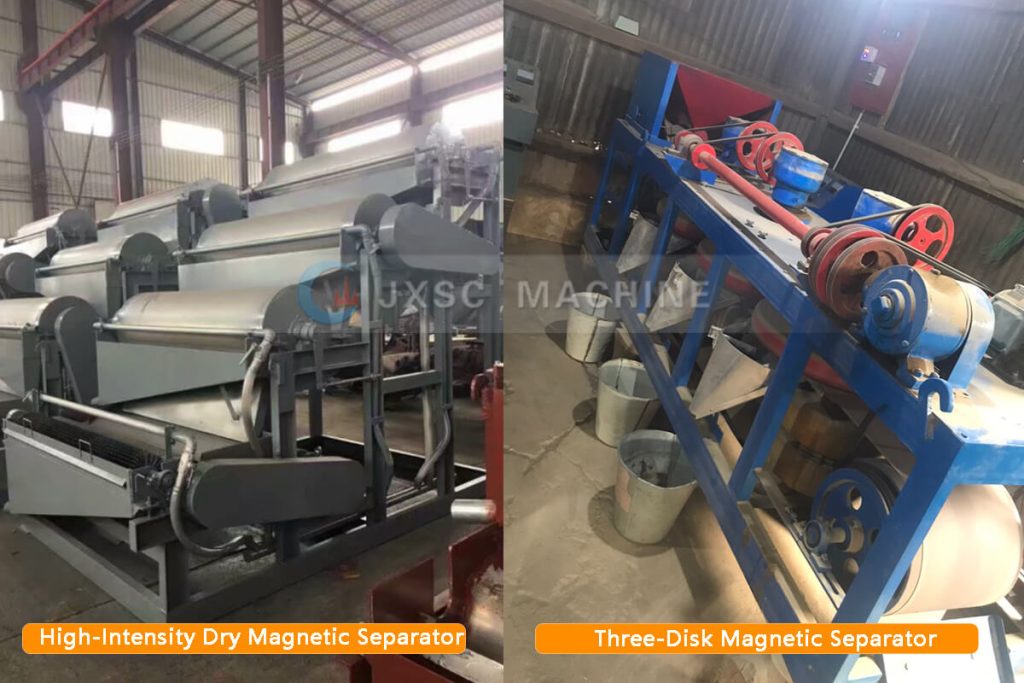
Common types of dry magnetic separators include drum, roller, and 3-disc magnetic separators.
Permanent magnet cylinders are mostly used for coarse-grained tailings, while magnetic rollers increase the field strength to grab fine-grained weakly magnetic minerals.
Three-disc magnetic separators are suitable for materials such as tin ore, ilmenite, and zircon, allowing for the extraction of three distinct products in a single pass.
Since different models vary in terms of feed particle size capacity and magnetic field strength ranges, equipment selection should be based first on the specific characteristics of the material, followed by an evaluation of the equipment’s technical parameters.
(3) Applicable Ores and Materials:
Strongly magnetic minerals, such as magnetite and ilmenite, as well as certain rare-earth minerals.
Weakly magnetic minerals, such as manganese and chromite ores, which require high-intensity magnetic roller separators.
Non-metallic minerals, including potash feldspar and ceramic raw materials—dry iron removal is particularly advantageous when downstream processes are sensitive to moisture.
Smelting slag, steel slag, and other industrial waste, where dry magnetic separation facilitates efficient processing and recovery.
(4) Advantages:
- No water is required, making it especially suitable for water-scarce regions.
- Dry concentrates can be loaded directly for transport; the absence of dewatering or filtration stages results in lower operational costs.
(5) Disadvantages:
Highly sensitive to the moisture content of the feed material; inadequate management of stockpiles during the rainy season can lead to inaccurate separation or, in severe cases, render the equipment inoperable.
Fine particles tend to develop static electricity and agglomerate (clump together) when dry, preventing proper dispersion and reducing recovery efficiency.
Significant dust generation occurs at the feed and discharge points, necessitating the use of auxiliary dust-collection equipment.
Moisture content in the ore exceeding 3% will negatively impact separation efficiency.
Wet Vs. Dry Magnetic Separation: Key Differences
| Comparison Item | Wet Magnetic Separation | Dry Magnetic Separation |
|---|---|---|
| Separation medium | Ore pulp, concentration 15%–30% | Dry material flow, no water required |
| Suitable ores | Weakly magnetic, micro-fine fractions (<3 mm), oxide ores | Strongly magnetic, coarse fractions, large lumps |
| Separation accuracy | Better performance on micro-fine fractions, stable recovery | Prone to agglomeration, relatively lower accuracy |
| Supporting facilities & cost | Water pool, pump station, tailings pond; more complex, slightly higher maintenance cost | Dust collection equipment required; simpler process, lower initial investment |
| Environmental profile | Wastewater requires treatment, but low dust generation | Heavy dust generation, dust-control measures required |
| Typical applications | Manganese and chromite concentrators, high-precision concentrate production | Water-scarce regions, roughing/pre-concentration stage |
Conclusion
Wet vs. dry magnetic separation: wet magnetic separation is ideal for high-precision requirements, while dry magnetic separation offers a cost-effective solution. Both methods have their own distinct advantages; the key to choosing the right one lies in aligning with your ore characteristics, environmental regulations, and investment budget. For personalized selection guidance or equipment customization, please contact us. JXSC provides you with efficient, energy-saving, and compliant ore magnetic separation solutions!